Two names, one thumbnail swish — and two genuinely different dresses. Listings swap “A-line” and “fit-and-flare” as if they were synonyms, but the waist seam never lies. This is the test that tells you which silhouette you are actually looking at.
Search for either name and the results blur together. Dresses titled “A-line” twirl like ballroom skirts; dresses titled “fit-and-flare” hang in one straight, quiet line. Some listings use both names in the same title. If the names can be swapped that freely, they can’t be carrying much information — and in a title, they aren’t.
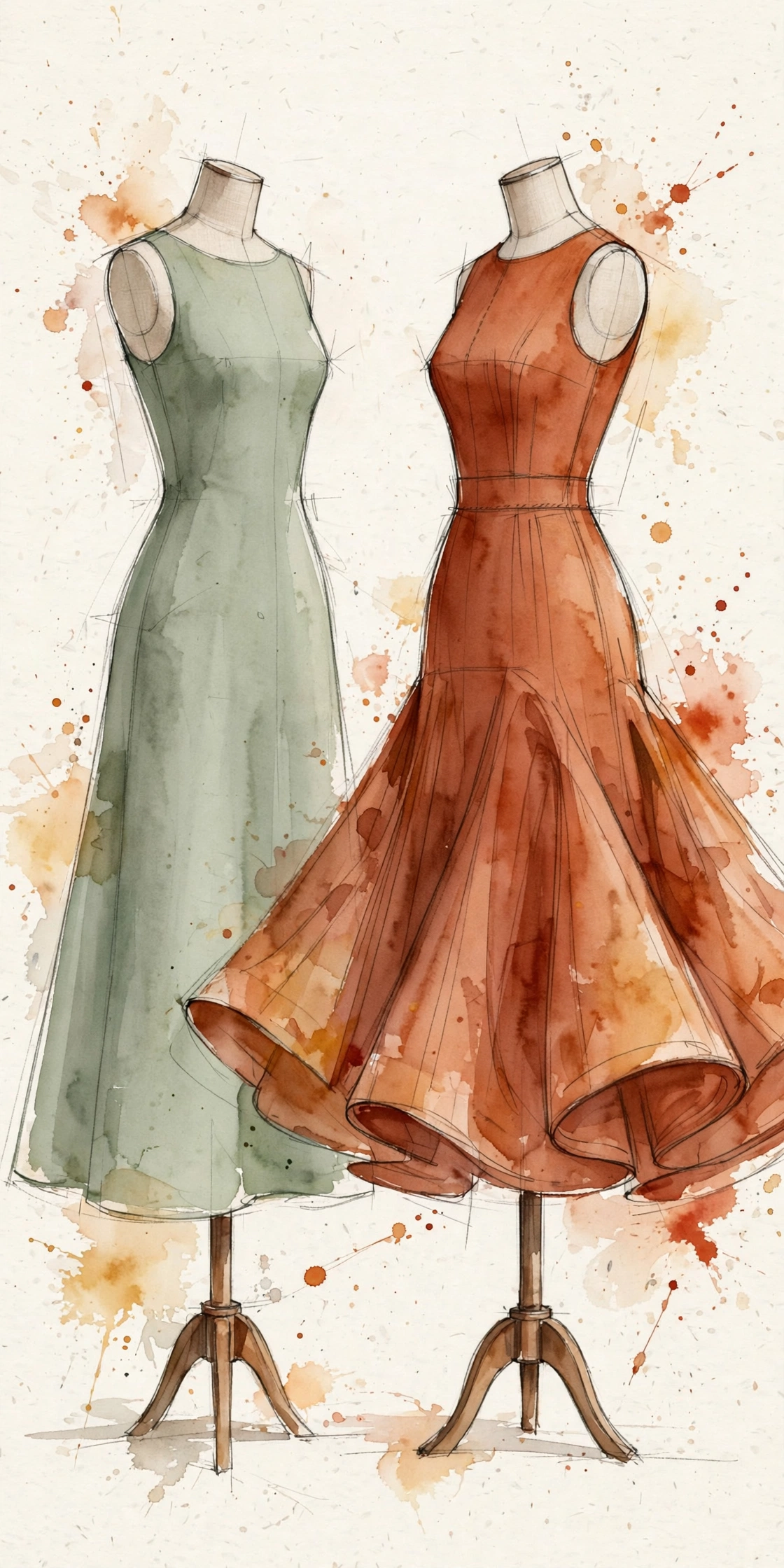
In the garment, they carry a great deal. A-line and fit-and-flare are two different constructions, and construction decides how a dress behaves: where it touches you, where it lets go, how the skirt moves, how much fabric you are actually buying. The difference in one sentence: a fit-and-flare is fitted through the bodice and the waist, then opens into its skirt at a defined waist; an A-line widens gradually in one continuous line from high on the body to the hem — the letter A it is named for. Everything else follows from that.
The test: look for the waist seam
Skip the twirl photo — both dresses twirl. Go straight to the waist, and look for a seam.
Fit-and-flare shows its join. In most product photos you can find it — a horizontal seam, a waistband, or a visible change where the fitted bodice ends and the skirt begins. Above that line the dress is snug; below it, the skirt is released — often dramatically, into circle, half-circle, or gathered volume. The seam is not decoration. It is the hinge the whole silhouette swings on.
A-line has no hinge. The fabric falls in one widening line, the flare beginning high and opening gradually all the way to the hem; the waist passes through the line rather than interrupting it. The result is a smaller hem sweep, a quieter skirt, and a silhouette that skims the hips instead of announcing them.
Why the guides disagree — and why the test survives it. Look this pair up and you will find two descriptions of A-line that seem to contradict each other: some guides call it a fitted bodice with a gentle flare from the waist; others, a dress with no waist seam at all, falling from the chest. Both circulate because real dresses sold under the name sit along a range — the widening can start higher or lower, and a seam may or may not be present. But neither description contains a sharp break at the waist: a fitted waist that ends and a fuller skirt that begins. That break defines fit-and-flare; its absence is the working definition of A-line. So don’t classify by which paragraph a listing copied. Classify by the break.
Cut by cut: where they actually differ
| Detail | A-line | Fit-and-flare |
|---|---|---|
| Where the flare starts | High on the body, opening gradually to the hem | At the waist, all at once |
| The waist | No sharp break — the line passes through it | Defined and fitted, usually with a visible seam or join |
| Skirt volume | Smaller hem sweep, simpler construction, fewer panels | Large sweep — circle, half-circle, or gathered skirt |
| Movement | A sway that follows you and settles quickly | A swing that leads — the skirt keeps moving after you stop |
| Fabric in the skirt | Less cloth, lighter skirt | More cloth, often panelled or gathered to manage it |
| Through the middle | Skims the waist and hips | Sits on the waist — the fit point of the dress |
Flare point. This is the master difference, the one the seam test reads. A fit-and-flare concentrates all of its widening at a single horizontal line; an A-line spreads the same decision over the whole length of the dress. Two dresses with identical hem widths can still be different silhouettes — it matters where the width arrived.
Volume. Because the fit-and-flare skirt starts from a fixed, fitted waist and still has to reach a wide hem, it needs circumference — cut as a full or half circle, or gathered into the seam. The A-line’s gradual slope reaches a modest hem with far less.
Movement. A fit-and-flare skirt swings, lifts, and keeps travelling for a beat after you turn; that is the quality the twirl photos are selling, and on this silhouette it is real. An A-line moves with the body and settles sooner — less theatre, fewer surprises in wind and on stairs.
Fabric. Volume is bought with cloth. A circle or gathered skirt consumes considerably more fabric than a gradual A-line skirt — part of why the fit-and-flare’s skirt carries more weight when you lift the hanger.
Choose by what you want emphasised
Neither silhouette is the flattering one. They emphasise different things, and the right choice is the one whose emphasis you actually want.
Choose A-line when you want the line left alone. It skims the waist and hips instead of marking them, reads classic, and travels easily from work to weekend. It is also the more forgiving construction: with no seam that must land exactly on your natural waist, it tolerates more variation in where your waist sits and in between-size days.
Choose fit-and-flare when you want the waist to be the event. The seam defines it, the skirt balances it, and the eye reads the hourglass whether or not the body underneath supplies one. It is the natural register of party dresses and most wedding-guest dressing — anywhere the movement of the skirt is part of the point. The trade is precision: the whole proportion depends on that seam landing on your waist, not above or below it. And a belt is not a conversion — belting an A-line draws a waist on for the day, but the construction underneath, and the way the skirt behaves, stays A-line.
The listing-decoding checklist
Run these six checks on any product page, whatever the title calls the dress.
1 · Find the waist. Zoom to the natural waist. A seam, waistband, or visible join where bodice meets skirt means fit-and-flare construction — whatever the listing named it.
2 · Trace the line. From bust to hem, does the outline widen in one unbroken slope, or pinch at the waist and open below it? Slope: A-line. Pinch and open: fit-and-flare.
3 · Measure the sweep. Compare hem width to shoulder width. A modest sweep supports A-line; a near-circle supports fit-and-flare.
4 · Read the construction words. “Circle skirt,” “half-circle,” “gathered at the waist,” “panelled skirt” describe fit-and-flare architecture. Their presence settles the question; their absence only leaves it open.
5 · Discount the belt. A belt can draw a waist onto an A-line for the camera. Look for the sewn seam in an unbelted shot or a detail photo. A belt is styling; a seam is construction.
6 · If the waist is hidden, score it unknown. Cropped photos, arms folded over the middle, fabric gathered in a hand — if you cannot see the waist, you cannot classify the dress, and the silhouette is the first of several things that listing isn’t telling you. Run the rest of it through the two-dress comparison template, and if coverage matters, the pre-purchase coverage checklist as well.
The habit
Listings name dresses to sell them. Seams have no such agenda. Once you have classified a few dresses by the break at the waist, the titles stop confusing you — you see the construction first and the name second, and the name becomes what it should have been all along: a claim you know how to check.
Two dresses will keep sharing a name in your search results. They were never the same dress. Now you can see which is which.