You keep seeing it everywhere and can’t tell if buying in is smart or next spring’s regret. Run any trend through five structural tests and get a clear verdict: adopt, adapt, or skip.

You’ve seen it seventeen times this week. In your feed, on the street, in the store window you pass on your way to buy toothpaste. A silhouette, a color, a detail — and each sighting makes it feel a little more inevitable, a little more like something you already own. That’s not your taste talking. That’s exposure doing its work.
Here’s the uncomfortable truth about that feeling: “do I like it” is the wrong question. Of course you like it. You’ve been shown it seventeen times. Liking is what trends manufacture; it’s the product, not the signal. The right question is quieter and much more useful: will this survive in my wardrobe?
Trends don’t die mysteriously. They die for structural reasons — the same reasons, every time. Once you know the failure modes, you can test any trend against them before you spend a cent. That’s what this framework does. Five tests, five minutes, one verdict: adopt, adapt, or skip.
Why trends actually die
Forget the fashion cycle as weather — mysterious, inevitable, nobody’s fault. Most trends fail for one of four structural reasons, and you can see every one of them in the historical record.
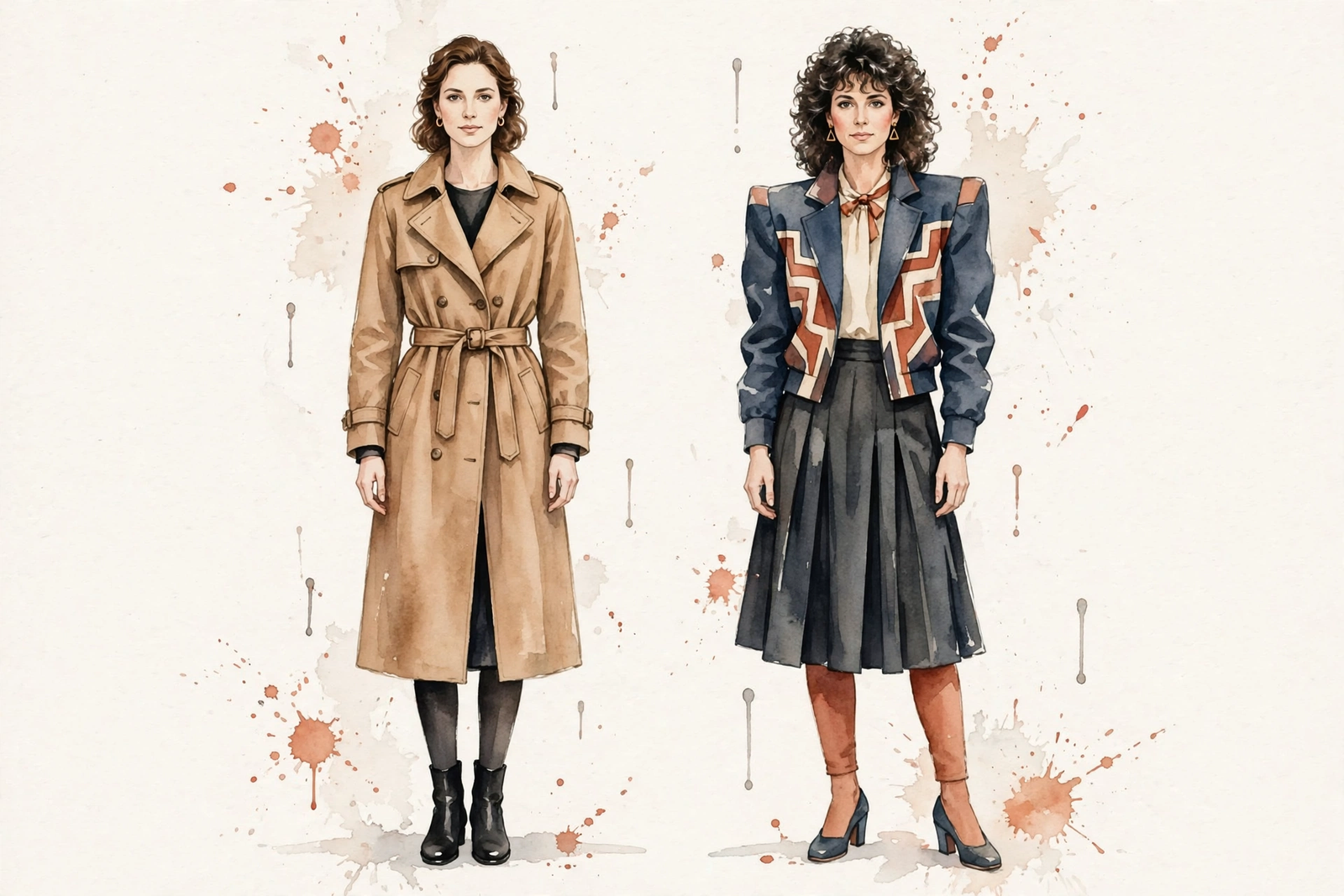
Single-context wearability. Some garments only work in one part of life. The 1980s power suit with its engineered shoulders was a complete uniform for the boardroom — and had nothing to say anywhere else. When the context shifted, the whole silhouette went with it.
Styling fragility. Some trends only look right under exact conditions. Bell-bottoms, at their 1970s peak, needed platform shoes to keep the hems off the ground and the proportions balanced — change the shoe, lose the look. A trend that collapses without its supporting cast is fragile by design.
No neutral anchor. Some pieces pair with nothing you already own. They arrive demanding an entirely new wardrobe around them, which means every wear is a production. Trends that can’t anchor to the clothes you have tend to get worn twice and shelved.
High maintenance cost. Some trends charge rent. Constant adjusting, special cleaning, careful storage, steaming before every wear. The early-2000s low-rise jean asked for a punishing fit equation — worn low, needing frequent adjustment, locked into one styling formula. Maintenance that high turns a garment into a chore, and chores don’t get worn.
Now the other side of the ledger. The pieces that crossed from trend to permanent fixture all share the opposite structure. Blue jeans went from 1873 riveted workwear to universal staple because indigo hid dirt, they paired with everything, and they worked in every context. The white t-shirt — a 1913 Navy undershirt — became outerwear in the 1950s and never left, because it has no detail to date it and anchors to anything. The trench coat survived a century past WWI because every detail is functional; nothing purely decorative, nothing to go stale.
These are historical examples, not predictions. Nobody in 1920 could have known the trench would last. But looking backward, the pattern is clear: what lasts has structure; what fades was missing it. The five tests below check for that structure in whatever you’re considering right now.
The five tests
Take the trend — the specific item you’re considering, not the vibe of it — and run it through all five. Answer honestly; the tests only work if you do.
1. The three-context test. Can you name three different parts of your life where you’d wear this? Work, weekend, evening. Or three seasons. Not “I could make it work for…” — three places it clearly belongs. A trend that lives in only one context is renting space in your closet, and the lease is short.
2. The easy-morning test. Does it look right thrown on, or does it need exact conditions — the right shoe, the right companion piece, the right hair, the right occasion? Get dressed in it mentally on a rushed Tuesday. If the outfit falls apart without staging, that’s styling fragility, and you’ll feel it every time you reach past it.
3. The closet test. Does it pair with at least three things you already own? Name them, specifically. A trend with no neutral anchor doesn’t just cost the price of the item — it costs the supporting wardrobe, or it costs the guilt of never wearing it. The most expensive trend is the one that needs friends.
4. The upkeep test. What does it actually cost to keep this wearable — not the price tag, the maintenance? Special cleaning, steaming, careful storage, adjusting throughout the day. Be honest about your real habits, not your aspirational ones. If you don’t steam things now, you won’t steam this either, and then it becomes the thing you “would wear if.”
5. The 2029 test. Imagine it’s two years from now and this exact item looks dated — the trend has moved on, nobody’s wearing it. Do you still reach for it? This is the sharpest question on the list, because it separates loving the garment from loving the trend. If the answer is yes, the trend was just the delivery mechanism for something you genuinely wanted. If no, you’re not buying clothes — you’re buying belonging, and belonging has the shortest lifespan of all.
The Five-Test Trend Check
Answer Yes or No to each test. Your verdict appears only once all five are answered.
An editorial method from The Brands Souk — a decision aid, not a validated assessment.
0 of 5 answered.
Your verdict
Four or five yeses — adopt. The structure is sound. Buy the best version you can reasonably afford, because this one stays. Trends that pass all five tests are how wardrobes quietly improve.
Two or three yeses — adapt. This is the most useful verdict on the list, and the least used. Don't buy the trend item — buy the idea in a quieter form. The trend color in a classic cut. The interesting silhouette in a neutral fabric. The detail on a shape you already trust. Adaptation gets you most of the feeling with a fraction of the risk, and the adapted version usually outlives the trend that inspired it.
Zero or one yes — skip. You don't want the garment; you want the feeling of newness, and newness is the one thing guaranteed to expire. Skipping is not deprivation. It's the decision your future self — the one not storing, maintaining, or guiltily avoiding this item — will thank you for.
A note on macro vs. micro
Not all trends are the same size. A macro shift — say, the broad move toward comfortable footwear, or the general loosening of silhouettes — changes the landscape slowly and tends to be forgiving; items bought into a macro shift have room to evolve. A micro-trend — a specific novelty detail, a hyper-particular cut — is binary: it's either current or it's over.
The five tests work for both, but calibrate the stakes. Failing the upkeep test on a micro-trend is a veto. Failing it on a macro shift might just mean choosing a lower-maintenance version. When in doubt, ask which one you're actually looking at. Most of what feels urgent in the feed is micro.
The cheapest trend
There's a final arithmetic worth doing. A $40 trend item worn twice costs $20 per wear — and then it costs closet space, maintenance attention, and the small guilt of avoidance for as long as it sits there. A trend skipped costs nothing and teaches you what you actually respond to: the color? the ease? the novelty itself? That information is free, and it's the most valuable thing this framework produces.
The question was never "is this trendy." Trends are, by definition, trendy — that's all the word means. The question is whether it will still be yours when the trend is over. Run the five tests. Trust the structure. And remember that "don't buy" is not the framework failing. Half the time, it's the framework working exactly as designed.