
Stop organizing by product category. Organize by routine — a worksheet that matches products to real occasions and cuts everything with no job.

Her makeup bag holds twenty products. She uses four. The rest are archaeology: a lipstick bought for an event in 2023, three mascaras in various stages of drying out, a contour palette from a tutorial phase, a foundation two shades off that she’s “keeping just in case.” Every few months she buys another lipstick — because lipstick is a category she understands — while the actual gap in her routine goes unfilled.
The problem isn’t discipline. It’s organization. Makeup is sold by category (face, eyes, lips) but worn by occasion (the ten-minute work morning, the weekend brunch, the evening out). A bag organized by category will always accumulate; a bag organized by routine can only contain what the routine needs. This worksheet builds the second kind.
The principle: every product needs an occasion
Here’s the entire method in one sentence: a product belongs in your bag only if you can name the recurring occasion it’s for.
Not “I might need it.” Not “it was expensive.” A recurring occasion — something that happens in your actual week, repeatedly. The ten-minute work morning is an occasion. Saturday errands are an occasion. Dinner out twice a month is an occasion. “A wedding I might attend someday” is not an occasion; it’s a fantasy, and fantasies don’t get bag space.
This is why buying by category fails. “Another lipstick” answers the question “what category am I missing?” — but no one ever needed a category. They needed something for the twenty minutes between waking up and leaving, or for the evening when the day look needs to become the night look. Organize by the job, and the categories sort themselves out.
Step 1: Map your week
Before touching the bag, map the routine. Write down your actual recurring occasions — not the ideal week, the real one. Most weeks reduce to three to five:
| Occasion | When it happens | Time available | What it needs to do |
|---|---|---|---|
| Work morning | Mon–Fri | 10 minutes | Polished, fast, lasts through the day |
| Weekend daytime | Sat–Sun | 20 minutes, unhurried | Fresh, minimal, comfortable |
| Evening out | ~2x/month | 15 minutes on top of day look | Elevate, not restart |
| Your fourth |
Be honest about frequency and time. An occasion that happens twice a month still counts — it’s recurring. If work mornings are genuinely ten minutes, the work-morning kit must be executable in ten minutes.
Step 2: Build the occasion matrix
For each occasion, list the product types needed — types, not brands, not specific products. Work occasion by occasion, and let products repeat across occasions — repetition is the point. A mascara that serves three occasions is earning its space three times over.
| Occasion | Product types needed |
|---|---|
| Work morning | Tinted moisturizer, concealer, brow pencil, mascara, lip tint |
| Weekend daytime | Tinted moisturizer, mascara, lip balm |
| Evening out | Day look + eyeliner, deeper lip color, blush |
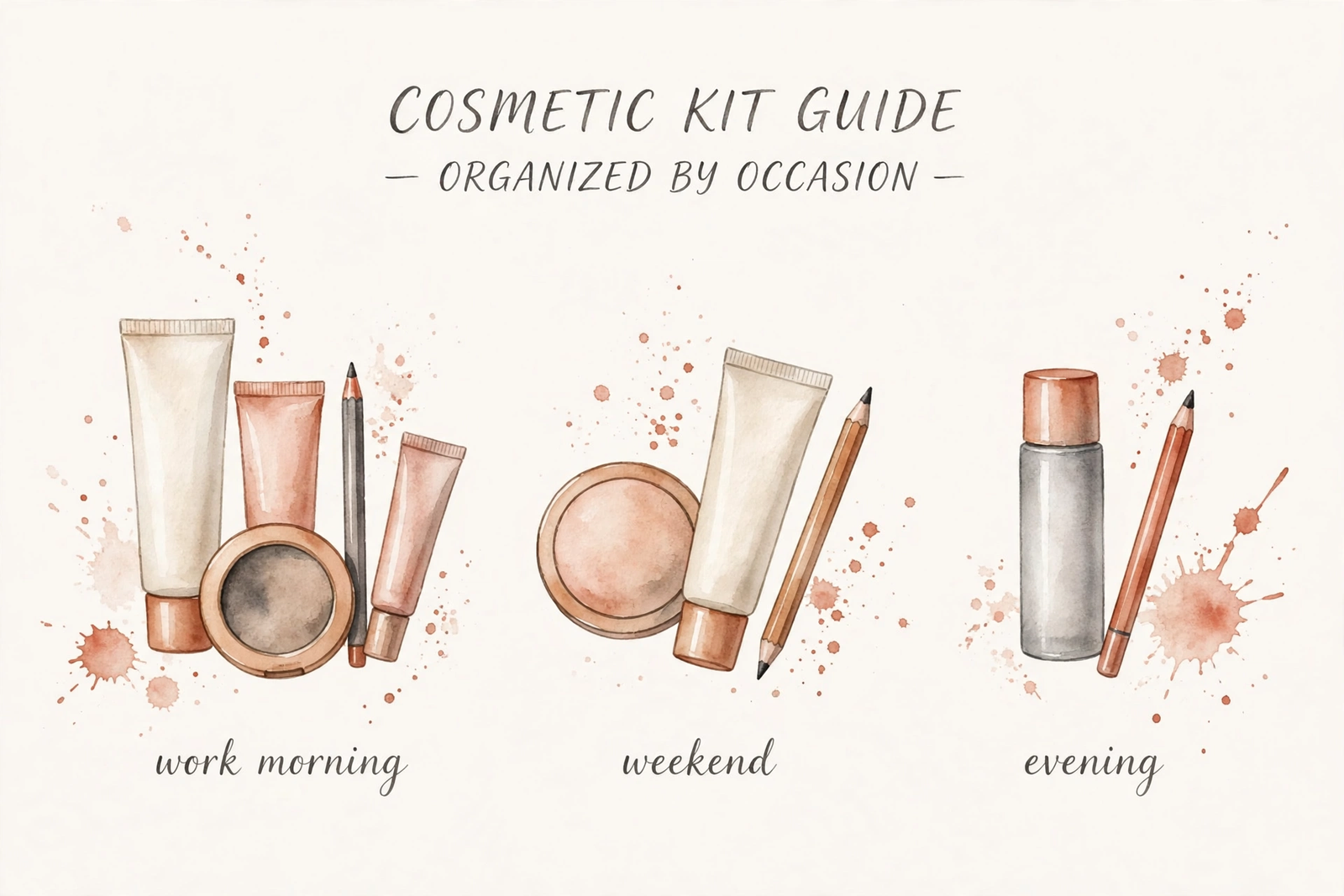
Notice what the matrix reveals: the weekend kit is three things. The work kit is five. The evening kit isn’t a separate bag — it’s two additions to the day look. Most women discover their real needs fit in a fraction of what they carry. The matrix also reveals the gaps honestly: if your evening column is empty because you own nothing for it, that’s a real gap — and the only kind worth buying to fill.
Step 3: The cut list
Now open the bag. For each product, ask the one question: which recurring occasion is this for? If you can name it, it stays. If you can’t, it goes on the cut list.
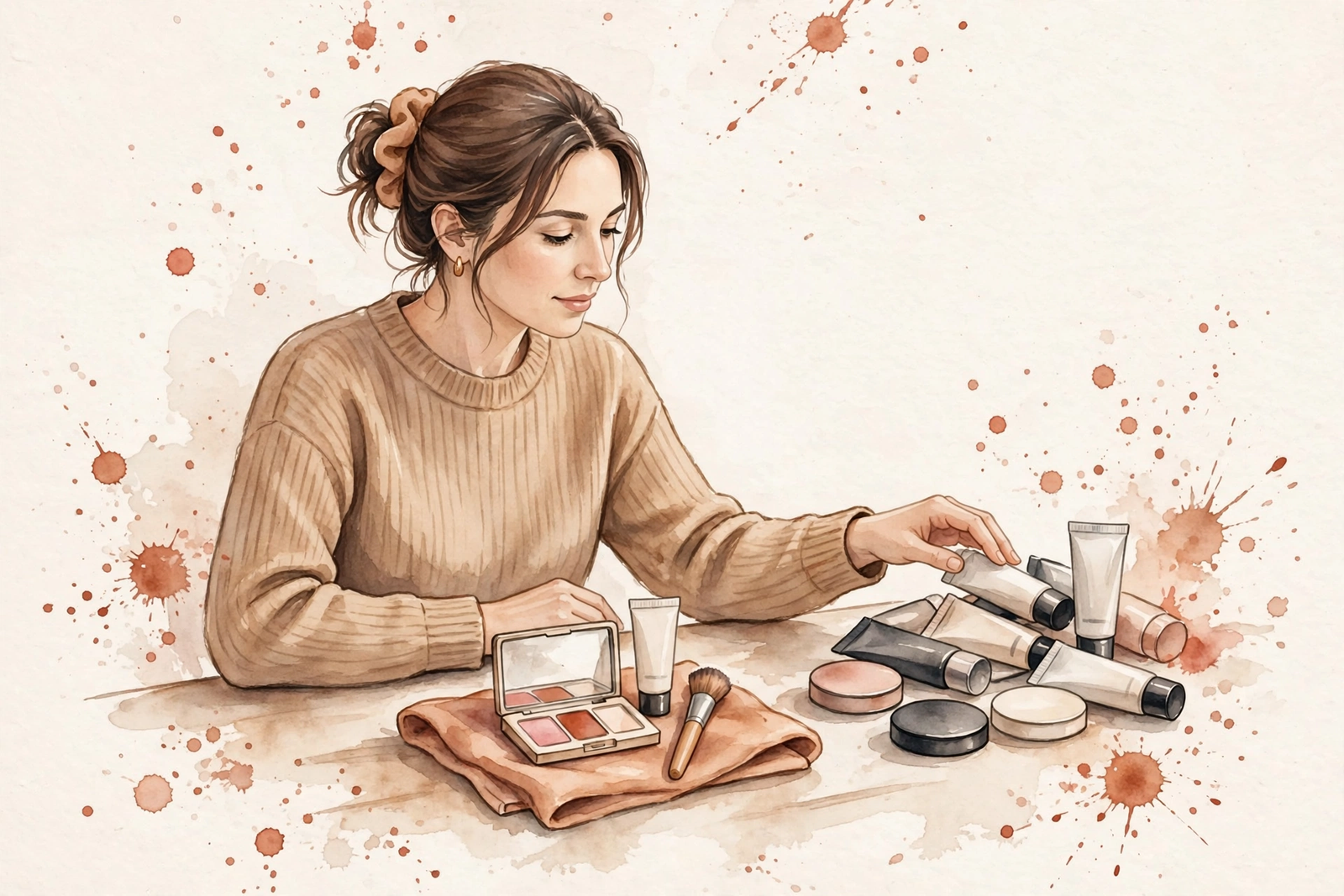
The cut list is not a trash list. Some cut items are perfectly good products with no occasion — the contour palette from the tutorial phase, the bold lipstick with no evening to attend. Those get stored, not carried; they’ll be there if the routine changes. Some are expired or dried out — those get discarded, because a dead mascara has no occasion either. The distinction matters: cutting isn’t punishment, it’s honesty about the routine you actually have.
Expect the cut list to be long the first time. That’s normal — it’s twenty products down to the eight or nine with jobs. The bag gets smaller, lighter, and — this is the part people don’t expect — faster. A bag where everything has an occasion is a bag you can pack in the dark.
Buying by gap, not by category
The worksheet changes how you shop, too. The next time you’re tempted by a product, don’t ask “do I have this category?” Ask “which cell of my matrix is empty?” If the answer is a real empty cell — the evening lip color you genuinely lack — it’s a considered purchase. If every cell is full, you’re not filling a gap; you’re adding archaeology. Walk away.
This is anti-consumption by design, and it’s the point. The beauty industry profits from category-based buying — another lipstick, another palette — because categories are infinite and occasions are not. A routine-based bag has a natural size limit: your week. Once the matrix is full, you’re done, and “done” is a wonderful place to be.
The bag that fits
A makeup bag built around your actual daily life won’t impress anyone on a vanity tour. It’ll be small, a little boring, full of repeats. But on a rushed Tuesday it will do its job in ten minutes, on a Saturday it will stay out of your way, and twice a month it will get you to dinner looking like yourself, elevated.
Twenty products, four used — that was never a discipline problem. It was an organization problem. Organize by routine, and the bag finally fits the life.