
You own four white tees but wear one. A wardrobe basic is a job description, not a clothing category — here’s how to tell which of yours are actually working, including the pieces you rarely wear.

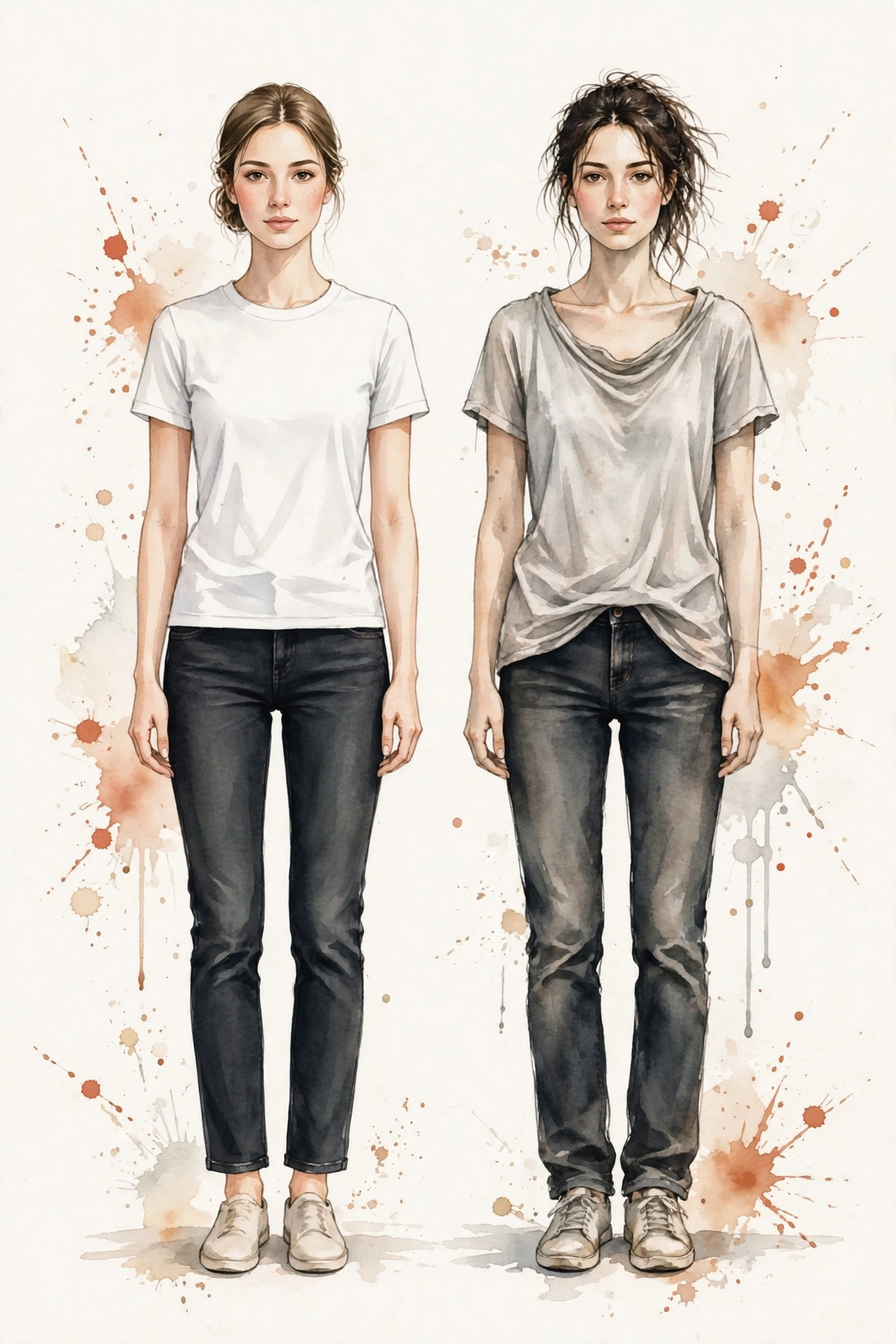
You own four white t-shirts. You wear one of them.
The other three aren’t terrible. They fit, more or less. The color is right. Nobody would open your drawer and call them bad clothes. But every morning your hand goes to the same one — the one whose collar still sits flat, whose body hasn’t gone soft and long, whose white hasn’t drifted toward gray. The other three are just… there. Taking up drawer space. Technically basics. Functionally, nothing.
This is the difference between a wardrobe basic and a wardrobe filler, and it has almost nothing to do with what the garment is.
A basic is not a category of clothing. It’s a job description. A white tee can be the hardest-working thing you own or a complete waste of cotton — same item, same color, same drawer. The difference is whether it does the job. And the job has three parts.
First, it pairs with at least three things you already own. A basic that only works inside one outfit isn’t a basic; it’s an outfit component with a good reputation. The white tee that goes under your blazer, with your jeans, and tucked into your midi skirt is doing basic-work. The white tee that only works with one specific pair of trousers is a specialist. Specialists are fine — but they don’t get to call themselves basics, and they shouldn’t be replaced on the “I need a new white tee” logic.
Second, it works across more than one kind of day. The test isn’t whether you could wear it somewhere; it’s whether you actually do. The tee that covers weekend errands and slides under a blazer for dinner is earning its keep twice over. The “nice” black trousers that only come out for events you attend twice a year are not failing — but they’re not basics either. They’re occasion pieces, and they get judged by a different standard (more on that below). The filler version is the garment that theoretically works everywhere and practically works nowhere: the sweater that’s slightly too warm for spring, slightly too thin for winter, and slightly the wrong neckline for layering. Versatility on the hanger; nowhere to go on the body.
Third, it survives being worn and washed regularly. This is where construction quietly decides everything. A basic gets washed more than anything else you own, which means it needs to be built for it. Two plain cotton tees can look identical on the rack and live entirely different lives: one holds its shape for two years, the other is a rag by spring. The difference is usually fabric weight and yarn quality — denser fabrics generally stand up to repeated washing better than feather-light ones, which tend to go sheer and lose shape faster. You don’t need to memorize numbers. You need to know that when a tee is suspiciously cheap and feather-light, its lifespan is part of the price.
None of this is about spending more. It’s about noticing that the garment doing the most work deserves the most scrutiny — and that most of us buy basics the way we buy batteries: grabbing whatever’s nearest, then wondering why nothing holds a charge.
Why fillers accumulate
Fillers don’t arrive by mistake. They arrive because buying them feels like progress.
A plain, neutral, inoffensive garment is the easiest purchase to justify. It doesn’t require imagination — it requires a hanger. It looks right in the store, where everything looks right. And each one carries a small, plausible story: this will be the backup tee, the travel sweater, the spare black trousers. The story is never exactly a lie. It’s just never exactly true either.
The most expensive kind of filler is the almost-right garment. The tee that’s slightly too thin. The trousers that are almost the right length. The cardigan in a neutral that matches nothing you own. Almost-right garments are never worn, because the flaw nags every time you consider them — but they’re never discarded either, because discarding them would mean admitting the purchase failed. So they sit, holding space and occasionally generating a fresh round of “I have nothing to wear” in front of a full closet.
The cost isn’t just money, though the money is real — three $25 tees that never get worn cost more per wear than one $60 tee worn a hundred times. The daily cost is decision fatigue: every filler in the drawer is one more non-option your brain has to sort through at 7 a.m. A closet full of fillers doesn’t give you more choices. It gives you more sorting.
The wardrobe role check
Here’s how to tell which is which. Take one candidate basic — the tee, the trousers, the sweater you keep meaning to wear — and answer six questions honestly. (The interactive tool below walks through them.)
The Wardrobe Role Check
Answer Yes or No to each row below — including both parts of question 2. Your result appears only once all rows are answered.
An editorial method from The Brands Souk — a decision aid, not a validated assessment.
The Occasion Test
0 of 7 answered.
Before anything leaves the closet, rule out three gentler explanations:
- Seasonality. A wool sweater assessed in July will fail the recency question through no fault of its own. Judge off-season garments by last season's wear, not this week's.
- Repair. A missing button or tired elastic is a maintenance backlog, not a verdict. If the fix is small and you'd do it this week, it's not a filler — it's a task.
- Occasion. If a real occasion is attached, the garment was never on the scored path — run the occasion test instead.
If none of those explain it, it's a filler. Let it go without ceremony; the drawer space is worth more than the garment.
The pieces you rarely wear
Some of the most valuable things you own are worn three times a year.
The blazer you bought for interviews — and then wore to every interview that got you the job. The dress that's right for weddings and nothing else. The heavy coat in a mild climate that earns its keep in one cold week. The hiking boots. The funeral-appropriate outfit nobody wants to think about until they need it. Judged by frequency, these are all failures. Judged by role, they're some of the hardest-working garments you own: when the occasion comes, nothing else in the closet can do what they do.
Frequency was never the test. Purpose is.

So if question 2's second half is your yes — kept for a specific, real occasion — skip the scoring and run the occasion test instead. Three questions:
1. Does the occasion still happen in your life? Interviews, weddings, formal events, specific weather, specific activities — name the last time it occurred and the next time it plausibly will.
2. Is this still the right garment for it? Fit, condition, appropriateness — the occasion hasn't changed its dress code out from under you.
3. Is it stored so it'll be ready? Clean, not crushed, not slowly being damaged in the back of the closet.
Three yeses: it stays, with purpose. It's not a filler; it's a specialist, and specialists are allowed. Any no: the occasion is gone, the garment no longer serves it, or it's deteriorating in storage — decide accordingly, without guilt either way.
Notice what this doesn't do: it doesn't pressure you to discard clothes, and it doesn't pressure you to buy replacements. A wardrobe full of working basics and well-chosen specialists needs almost nothing. That's the point. The goal was never a smaller closet or a bigger one. It was a closet where everything in it has a job — and does it.
What to do with the verdicts
Work through your basics one category at a time — tees one day, trousers another. Don't do the whole closet at once; decision fatigue is what got you here.
For the keepers, notice what they have in common. That's your actual personal specification — the fabric weights, fits, and colors that work for your life. Write it down somewhere. It's worth more than any shopping guide.
For the fix-or-replace pile, be specific about the fix. "Tailor the waist" is a plan; "maybe get it altered someday" is a filler with extra steps. If the fix costs more than the garment is worth to you, it's not a fix — it's a replacement decision.
For the garments that leave, don't replace them one-for-one. A gap in the drawer is information: it tells you exactly what to look for next time, with your new specification in hand. And the next time you're tempted by a plain, neutral, inoffensive garment that looks right on the hanger, run question 6 before you buy: would I buy this again at full price? Asked in the store, before the money is spent, it's the cheapest question on this list.




[…] Everything else — including the wardrobe fillers. (If you haven't read it, our piece on the difference between a wardrobe basic and a wardrobe filler is the companion to this audit: fillers are the pieces that take up space without doing a job.) The […]